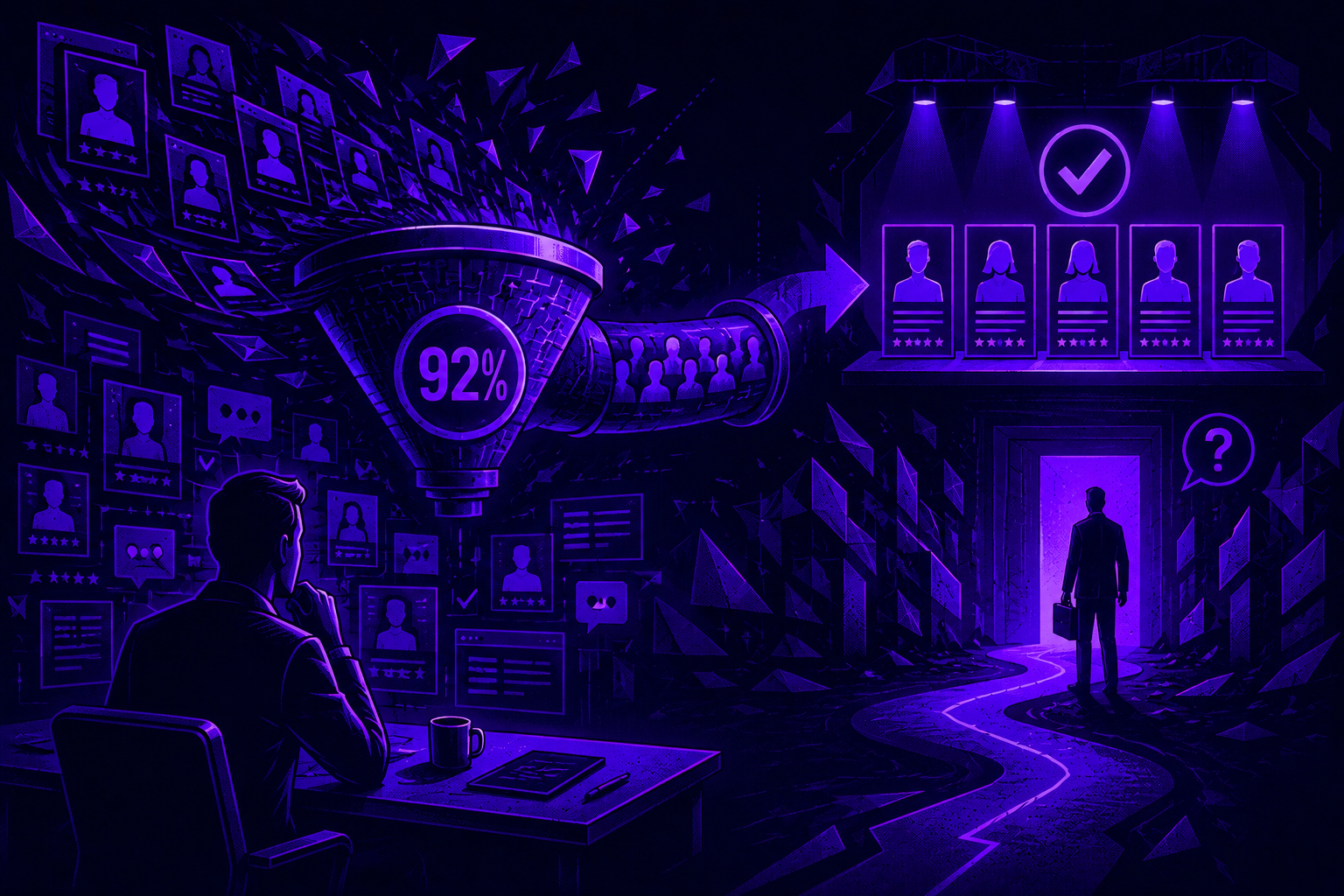
Your most valuable asset is also your greatest liability. The customer data that fuels your personalization algorithms, trains your fraud detection models, and sharpens your forecasts is entangled in a web of privacy regulations, security risks, and scarcity. You need immense, diverse, and clean datasets to build competitive AI, but collecting the real thing is fraught with ethical, legal, and practical landmines.
Enter the quiet revolution that is bypassing this entire dilemma: Synthetic Data. This isn't anonymized data, it's artificially generated data, created by algorithms to mimic the statistical patterns and properties of your real-world data, but without containing any trace of an actual person, transaction, or sensitive event. It’s a photorealistic simulation of your data universe, enabling you to innovate and iterate at a scale and speed previously deemed impossible or irresponsible.
We are moving from an era of data extraction to one of data creation. Synthetic data isn't just a privacy tool; it's becoming the foundational feedstock for the next generation of AI, allowing businesses to build more robust, unbiased, and powerful models in a fraction of the time.
What Exactly Is Synthetic Data?
Imagine teaching an AI the "idea" of a customer transaction, the typical amounts, frequencies, merchant categories, and sequences, without showing it a single real credit card number. The AI generator learns these underlying patterns and then produces an entirely new, fictional dataset that behaves just like the original for analytical purposes.
- It is statistically similar, but not identical. It preserves the correlations, distributions, and outliers of your production data.
- It is privacy-proof by design. Since rows are not linked to real individuals, it falls outside the scope of GDPR, CCPA, and other stringent regulations.
- It is flexible and scalable. You can generate millions of rows in minutes, engineer rare edge cases (like a novel type of fraud), or create data for scenarios that don't yet exist (like a brand-new product line).
Why the Shift from Real to Synthetic is Accelerating
The drivers for adoption are converging from multiple, critical angles:
- The Privacy Imperative: With regulations tightening globally, using real customer data for development, testing, and third-party sharing is a growing legal and reputational risk. Synthetic data provides a compliant bypass.
- The Scarcity Problem: For rare events (e.g., fraudulent transactions, machine failures, rare diseases) or new markets, real data is insufficient to train accurate AI. Synthetic data can fill these gaps responsibly.
- The Bias Mitigation Challenge: Real-world data often encodes historical biases. Synthetic data generators can be guided to produce more balanced datasets, helping to create fairer AI models.
- The Collaboration Enabler: It allows companies to safely share dataset "proxies" with external partners, vendors, or research institutions without compromising confidentiality.
The Two Primary Flavors of Synthetic Data
Understanding the type is key to application:
1. Structured Synthetic Data
This mimics traditional row-and-column data (CSVs, database tables). It's used for:
- Finance: Generating synthetic transaction histories to train fraud detection models without exposing real customer data.
- Healthcare: Creating synthetic patient records for medical research and drug discovery, preserving statistical utility while protecting PHI.
- Retail: Simulating customer purchase journeys to stress-test new recommendation algorithms.
2. Unstructured Synthetic Data
This mimics images, video, text, and audio. It's used for:
- Autonomous Vehicles: Generating millions of simulated driving scenarios with rare weather conditions or pedestrian behaviours.
- Computer Vision: Creating synthetic images of manufactured parts with microscopic defects to train quality assurance AI on the assembly line.
- Contact Centres: Simulating thousands of synthetic customer service call transcripts with varied emotions and requests to train dialogue AI.
Strategic Use Cases: Beyond Privacy Compliance
Forward-thinking brands are leveraging synthetic data for competitive advantage:
- Accelerating Time-to-Market: A fintech can use synthetic financial records to develop and test a new loan underwriting model in weeks, not the months it would take to collect and cleanse real, compliant data.
- Stress-Testing Systems at Scale: An e-commerce platform can simulate a sudden, massive spike in traffic (like a Black Friday scenario) using synthetic user behavior data to test website resilience without impacting real customers.
- Enabling Secure Innovation Sandboxes: Data scientists can freely experiment with high-fidelity synthetic datasets that behave like production data, allowing for rapid prototyping and innovation without ever touching a regulated data environment.
The Challenges and Considerations
Synthetic data is powerful, but not a magic bullet.
- Fidelity & Validity: The "goodness" of synthetic data depends entirely on the quality of the generator model and the real data used to train it. Garbage in, garbage out still applies. Rigorous validation against key statistical metrics is non-negotiable.
- The "Plasticity" Risk: If the synthetic data over-simplifies or misses subtle, real-world complexities, models trained on it may fail when deployed in production. It is a supplement and accelerator, not always a full replacement.
- Technical Expertise: Implementing a robust synthetic data pipeline requires specialized skills in machine learning and data engineering.
The Conclusion
The future of data-centric innovation will not be constrained by what we have collected, but powered by what we can responsibly imagine and generate. Synthetic data represents a fundamental mindset shift: from treating data as a finite, mined resource to treating it as an infinite, engineered material.
It allows you to build and test in a parallel, risk-free universe before deploying in the real one. The question is no longer if you will use synthetic data, but where and how you will deploy it first to outpace competitors still shackled by the limitations of their real-world data.
The most agile companies of tomorrow will be those that master the art and science of data creation today.
Ready to explore how synthetic data can de-risk your AI initiatives and accelerate innovation? Let's build a targeted pilot to generate value in your highest-friction area. Book a complimentary Data Strategy Session.